When you're choosing a wedding photo sharing app, privacy probably isn't the first thing on your mind. You're thinking about ease of use, how many photos you'll collect, and whether grandad will be able to figure out the QR code.
Your wedding album is also a detailed collection of personal data about your family and friends. And where that data goes depends entirely on which platform you use to collect it.
What your wedding photos contain
Clear, well-lit photos of faces - often from multiple angles across the day. Photos of children. Photos taken in private moments: tears during the vows, exhausted laughter at the end of the night, quiet conversations between family members.
Many of these photos will have identifiable context around them. Table plans in the background showing names. Place cards. Order of service booklets. Venue addresses on signage. The metadata attached to the photos contains timestamps, GPS coordinates, and device information.
When dozens of guests upload hundreds of these photos to a platform, the result is a rich dataset - the kind of thing that's valuable to anyone in the business of training AI models, building advertising profiles, or harvesting biometric data.
Where most wedding apps store your photos
The majority of wedding photo sharing apps store your images on cloud infrastructure provided by Amazon Web Services (AWS), Google Cloud, or Microsoft Azure. There's nothing inherently wrong with this - these are reliable, secure platforms. But there are important nuances that most wedding apps don't tell you about.
First, data location. Unless the app specifically guarantees UK or EU data residency, your photos may be stored in US data centres. US data protection law is materially different from UK GDPR, and subject to access frameworks that don't exist in the UK.
Second, third-party processing. Some wedding apps that offer facial recognition don't run the technology themselves - they use external providers like Amazon Rekognition or Google Vision. This means your photos are sent to a separate company's infrastructure for facial analysis. The wedding app might be perfectly trustworthy, but your data is now in two places, subject to two companies' privacy policies.
Third, terms of service. Some platforms include broad licences in their terms that allow them to use uploaded content for "improving services" or "product development." In plain English, that can mean using your photos to train their algorithms.
What to look for in a photo sharing app
If privacy matters to you - and if your wedding photos will include children, elderly family members, or anyone who's cautious about their digital footprint - here are the questions worth asking before you choose a platform.
Where are photos stored? Look for a specific answer: "UK data centres" or "EU data centres" with named locations. If the answer is vague ("secure cloud storage") or absent, assume the data could end up anywhere.
How does facial recognition work? If the app offers face grouping or recognition, find out whether it's processed in-house or through a third-party provider. In-house processing on the same servers as your photos is significantly more private than sending images to an external service for analysis.
What are the terms for your content? Read the relevant section of the terms of service. You're looking for language that explicitly limits the platform's rights over your photos - something like "we claim no ownership or licence over your content." Be wary of terms that grant "worldwide, royalty-free, non-exclusive licences" to your uploads.
What happens to your data afterwards? Check whether the platform deletes your photos after your access period, or whether they retain data indefinitely. A clear deletion policy - "we delete all data within 30 days of your access period ending" - is a good sign.
How Gather & Group handles privacy differently
We built Gather & Group with privacy as a core design principle, not an afterthought.
Our servers are in the UK. Every photo uploaded to Gather & Group is stored on UK infrastructure, covered by UK GDPR. We don't use overseas sub-processors for image storage or processing.
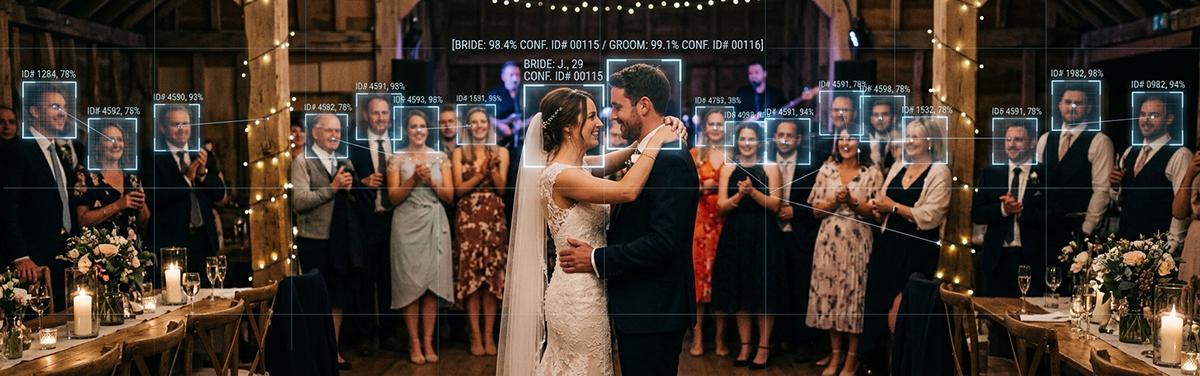
Our facial recognition is local. We run facial recognition models on our own servers. When a guest uploads a photo, the faces in it are detected and matched against other faces in your album - all within our infrastructure. The facial data is never sent to Google, Amazon, Microsoft, or any other third party. It's never used for any purpose beyond grouping photos in your album.
We don't use your photos for anything. Your photos exist in your album, for you. We don't use them for marketing, training, analytics, or "product improvement." We don't share them with partners.
When your access period ends, we delete everything. Photos, facial data, account information - it's all removed from our servers.
Read more about our privacy approach.
A note on proportionality
Privacy doesn't have to mean paranoia. Most wedding photo apps are perfectly fine for most couples. The vast majority of platforms aren't doing anything sinister with your photos.
But if you're someone who cares about where your data goes - or if your guest list includes people who are cautious about their digital privacy - spend five minutes checking how your chosen platform handles things. The information should be easy to find. If it isn't, that tells you something too.
Gather & Group keeps your wedding photos on UK servers with local facial recognition and privacy protections. Create your private album.